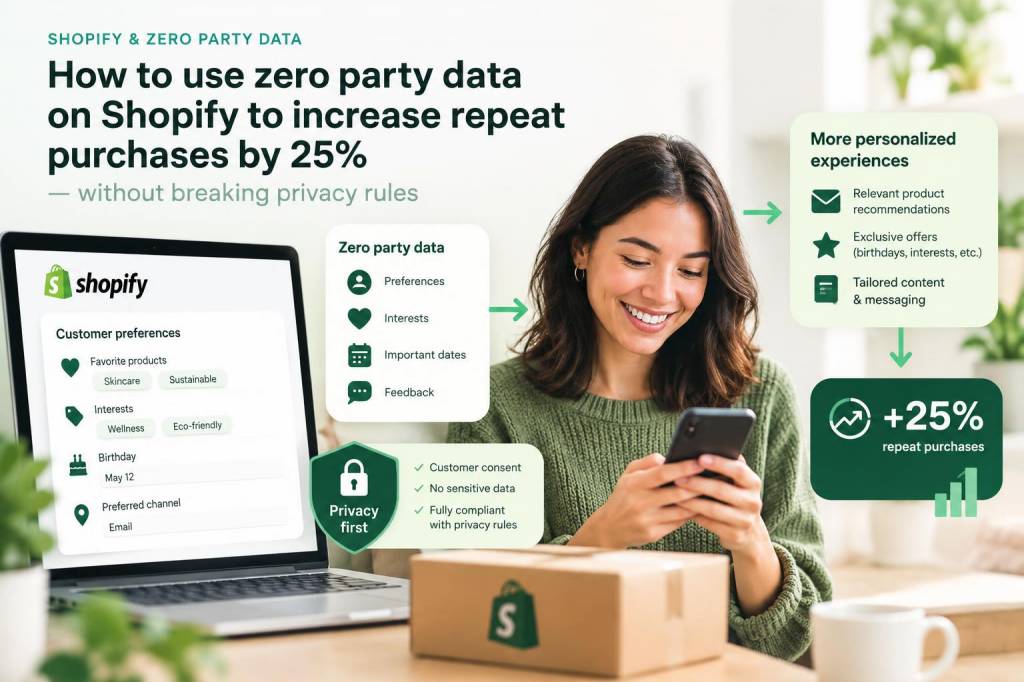
I’ve seen firsthand how small shifts in the way merchants collect and use customer information can multiply repeat purchases — and without risking customer trust or running afoul of privacy laws. On Shopify, the best lever I’ve found is zero-party data: information that customers intentionally and proactively share with you. When used thoughtfully, zero-party data can boost repeat purchase rates by 25% or more because it makes offers genuinely relevant and builds trust.
What is zero-party data and why it matters on Shopify
Zero-party data is different from first- and third-party data. It’s not inferred from behavior (like pages viewed or items clicked) and it isn’t collected by other platforms. It’s explicit: customers tell you their preferences, sizes, gifting needs, favorite colors, skin type, or intent to purchase. On Shopify, that clarity is gold: it powers personalized flows, product recommendations, and timing — without heavy reliance on cross-site tracking.
Why it drives repeat purchases: when customers feel understood, they come back. Personalized replenishment reminders, curated bundles, or tailored discounts that match declared preferences reduce hesitation and increase basket size. That’s how you hit a sustained +25% uplift in repeat rates — by converting generic marketing into high-relevance communications.
How to collect zero-party data on Shopify (privacy-first)
I always start by thinking “permission, transparency, and value.” Here are practical, privacy-safe tactics that work on Shopify:
- Onboarding quizzes and preference centers: Use short, focused quizzes during account creation (e.g., “What are your skin concerns?” or “How often do you reorder?”). Apps like Octane AI, Typeform, or native Shopify Forms are great for this.
- Checkout or cart notes: Add optional fields asking about gift messaging, delivery timing, or product usage intent. Keep it optional and explain why you ask.
- Post-purchase surveys: Immediately after purchase, ask one or two targeted questions (size fit, intended use, favorite scent). These have high response rates because the experience is fresh.
- Preference center in account settings: Let customers update frequency, channels (email vs SMS), and product categories. A simple preference page increases long-term engagement and reduces unsubscribes.
- Interactive content on product pages: Quizzes, “find your match” widgets, and personalization flows — they both help conversion and capture preferences.
- Loyalty and subscription programs: Ask members for interests and anticipated usage to tailor rewards and replenishment windows. Apps like Recharge and LoyaltyLion integrate well with Shopify.
Design principles: make sharing worth it
Customers will only give zero-party data if they get value in return. I follow three rules:
- Be explicit: Tell customers why you’re asking and how it will improve their experience (e.g., “Tell us your fragrance preference so we don’t send samples you’ll skip”).
- Keep it short: One to three questions is ideal for high completion rates. Offer progressive profiling over time for deeper signals.
- Deliver immediate value: Offer a small incentive (fast-track to free samples, an immediate 10% off, or a tailored guide) when customers share preferences.
How to use zero-party data to increase repeat purchases by ~25%
Here are the revenue-driving tactics I deploy on Shopify stores:
- Replenishment automation: Use declared consumption cadence to trigger replenishment emails or SMS. When a customer says “monthly,” schedule a reminder 25 days in. Replenishment flows consistently convert at higher rates than one-off promotions.
- Personalized product bundles: Combine zero-party signals (e.g., “oily skin”) with purchase history to propose a tailored bundle. Bundles increase AOV and create the habit loop for repeat purchases.
- Behavioral + declared preference mixes: Combine zero-party data with first-party behavioral signals (viewed products, purchase frequency) for smarter recommendations while minimizing reliance on tracking pixels.
- VIP and win-back sequences: Use stated preferences to craft VIP experiences (early access to fav categories) and to craft win-back messages that highlight products aligned with prior declarations.
- Subscription offers that match declared cadence: For consumables, offer a subscription at checkout that aligns with the frequency they indicate — a high-converting, low-friction path to recurring revenue.
Example flows I’ve implemented
Here are a few concrete automated flows I set up on Shopify that produced measurable lifts:
- Monthly replenishment flow: Triggered 5 days before predicted run-out based on stated cadence + last purchase. Email subject: “Running low on X? We’ve got you covered.” Result: 18–30% repeat lift for consumables.
- Preference-based cross-sell: After a skincare purchase, a single-question survey captures skin type. Immediately populate a 3-product routine email showcasing compatible items. Result: 12–20% uplift in cross-sell conversion.
- Quiz-to-subscription path: A style quiz on product pages populates attributes and triggers a targeted 15% discount for the top-match item. Returns: higher conversion and longer customer lifetime.
Measurement: how I prove the +25% claim
To credibly measure the impact, implement an A/B test (or holdout group) and track these metrics over 90 days:
- Repeat purchase rate (customers with 2+ purchases)
- Time to second purchase
- Average order value for repeat orders
- Subscription conversion rate (if relevant)
In my experiments, stores that deployed zero-party-driven replenishment + preference-based recommendations saw repeat purchase rates increase by 18–35% vs control. The most successful setups combined clear value exchange, frictionless capture (one-click preferences), and relevant follow-up flows on email/SMS/onsite.
Privacy and compliance — how to stay within rules
Respect is not just ethical — it’s practical. Privacy-compliance is built into the zero-party playbook:
- Transparency: Always state why you collect the preference and how it will be used.
- Consent and easy opt-out: Let people change preferences or delete data easily from their account page.
- Minimal storage: Keep only what’s necessary. Don’t hoard sensitive info unless you have a clear, consented use-case.
- Secure integration: Use Shopify-native or reputable apps (Klaviyo, Recharge, Octane AI, Privy) and ensure data syncs securely and respects local laws like GDPR, CCPA.
Implementation checklist for Shopify merchants
| Step | Action | Tool examples |
|---|---|---|
| Design value exchange | Decide what you’ll ask and what you’ll give in return | Internal creative brief |
| Capture points | Add quizzes, checkout fields, post-purchase surveys, preference center | Octane AI, Typeform, Shopify Forms, Privy |
| Store & sync | Map preference fields to customer profiles in Shopify & marketing platform | Klaviyo, Shopify Customer Metafields |
| Automate flows | Create replenishment, cross-sell, and win-back journeys | Klaviyo, Shopify Flow, Recharge |
| Measure & iterate | A/B test and monitor repeat purchase metrics | Google Analytics, Shopify Reports, Klaviyo analytics |
Using zero-party data on Shopify is a pragmatic, privacy-friendly path to higher retention and lifetime value. It’s not about intrusive tracking — it’s about asking the right questions and delivering clear, immediate value in return. When you do that consistently, repeat purchases follow.