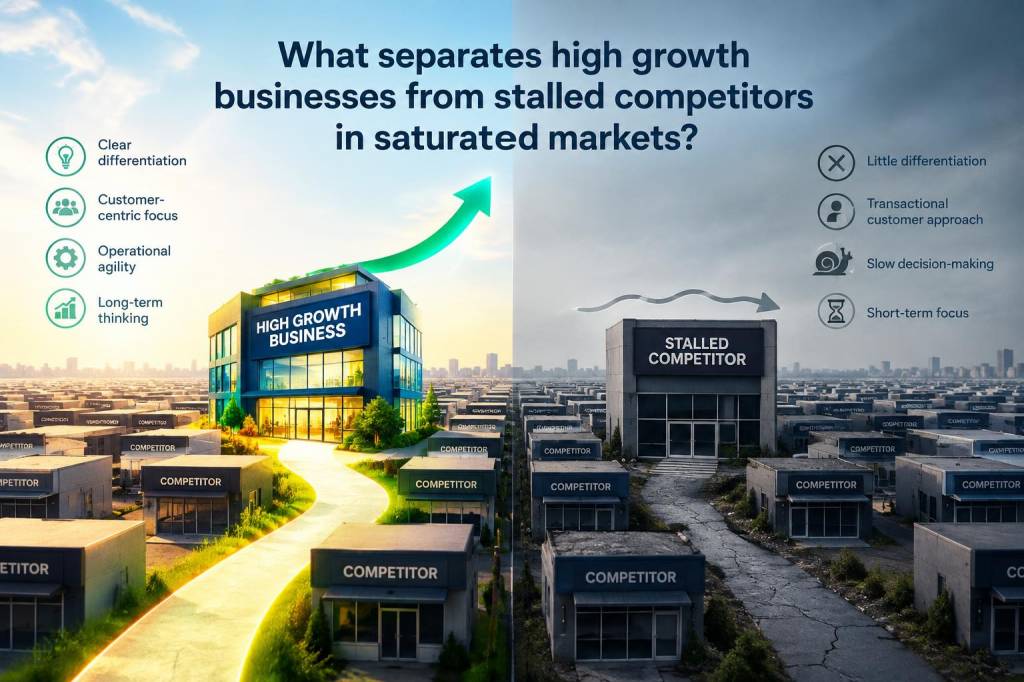
In saturated markets, I have noticed a pattern that repeats itself with surprising consistency: some businesses keep accelerating while others lose momentum, even when they offer products that look similar on paper. From the outside, it can seem like luck. Inside the numbers, it is usually something much more practical. High-growth businesses are not simply louder, cheaper, or more visible. They are usually better at choosing where to compete, how to adapt, and what to ignore.
When I study companies that keep growing in crowded categories, I rarely see a single magic move. I see a chain of disciplined decisions that compound over time. They know their audience with unusual clarity. They sharpen their positioning until it feels almost inevitable. They build systems that learn faster than competitors. And, perhaps most importantly, they resist the temptation to copy everything the market rewards in the short term.
Clarity of position matters more than broad appeal
One of the clearest differences I see between growing businesses and stalled competitors is positioning clarity. Stalled businesses often try to be useful to everyone, which makes them memorable to no one. High-growth businesses usually choose a narrower promise and defend it relentlessly.
I have seen this across many sectors. In software, for example, a company like Notion did not try to become every type of productivity tool at once. It built a distinct identity around flexible workspaces. In ecommerce, a brand may grow quickly not because it sells more products, but because it owns a sharper idea in the customer’s mind: faster delivery, premium craftsmanship, stronger sustainability, or a more relevant niche.
This matters because saturated markets punish confusion. If a customer cannot explain what makes you different in one sentence, they will usually default to the brand they already know. High-growth businesses remove that friction. They make the buying decision feel easy.
They focus on a specific customer problem, not a generic market segment
I often hear companies describe their audience in broad terms: “small businesses,” “young professionals,” “busy families,” or “mid-market teams.” Those labels are useful for internal organization, but they are not enough to create growth. High-growth businesses go deeper. They identify a painful, recurring problem and build around that pain.
That difference changes everything. Instead of asking, “Who could possibly buy this?” they ask, “Who feels this problem most urgently, and what would make solving it urgent enough to act now?” This shift leads to stronger messaging, better product design, and far more efficient marketing spend.
When I look at companies that break through in crowded categories, I usually see one of these patterns:
- They serve an audience with a problem that competitors have ignored.
- They solve an existing problem with much less effort for the customer.
- They reframe the problem in a way that makes the value obvious.
- They reduce risk, time, or confusion in the purchase process.
That is why some brands can grow with smaller budgets. Their message lands because it speaks to a real moment of frustration, not a vague demographic profile.
They build a learning loop faster than everyone else
Growth in saturated markets is rarely about having the perfect plan from day one. It is about learning faster than rival firms. The businesses I admire most treat every campaign, product update, and customer interaction as a source of intelligence.
I have seen stalled competitors make a familiar mistake: they gather data, but they do not turn it into action quickly enough. Reports sit in dashboards. Insights remain in presentations. High-growth businesses close that gap. They test, measure, adjust, and repeat with discipline.
In practice, this means they ask sharper questions:
- Which segment converts with the highest lifetime value?
- Which message creates the strongest response at each stage of the funnel?
- Which product feature drives retention, not just acquisition?
- Which channel scales without degrading margins?
The businesses that keep growing are usually not the ones that know more in a static sense. They are the ones that learn faster in motion. That speed becomes a competitive advantage because the market does not stay still long enough for indecision to be harmless.
They use brand as a growth asset, not a decoration
In crowded markets, brand often gets treated as a visual layer: logo, colors, tone, maybe a campaign slogan. That is a shallow view. High-growth businesses treat brand as a strategic asset that reduces acquisition cost, strengthens trust, and increases willingness to pay.
I have watched businesses with similar products achieve very different outcomes because one built stronger emotional meaning. Customers do not just buy functionality. They buy confidence, identity, convenience, and social proof. A strong brand makes those benefits easier to feel.
That does not mean a brand must be loud or polished in a superficial way. It means the promise must be consistent. Every touchpoint should reinforce the same expectation. When that happens, marketing becomes more efficient because each impression adds to a recognizable story instead of starting from zero.
Stalled competitors often underinvest here. They chase short-term response metrics while ignoring the cumulative effect of trust. High-growth businesses understand that performance marketing and brand building are not opposites. They are partners.
Pricing discipline separates confidence from desperation
I have noticed that businesses in stagnant phases often compete on price too early. They treat lower pricing as a shortcut to demand, but all they usually create is a race to the bottom. High-growth businesses are more disciplined. They price according to perceived value, customer outcome, and long-term positioning.
This does not mean they never discount. It means they know when discounting supports strategy and when it simply signals weakness. A business that grows steadily in a saturated market usually does one or more of the following:
- It packages value in a clearer way.
- It tiers offerings so different buyers can self-select.
- It raises price where proof of value is strongest.
- It avoids training customers to wait for promotions.
I have seen pricing become a growth engine when it reflects a sharper understanding of value. If a product saves time, reduces risk, or improves outcomes in a measurable way, the price should communicate that. Underpricing can create volume, but it can also quietly erode momentum if the business cannot reinvest enough in product, service, or acquisition.
They align product, marketing, and sales around one story
Another difference I see is internal alignment. In stalled companies, product teams, marketing teams, and sales teams often operate with different assumptions about what the company is actually selling. That creates confusion for customers and inefficiency inside the business.
High-growth businesses usually maintain a single core story that runs through every function. The product delivers on it. Marketing amplifies it. Sales personalizes it. Support reinforces it. This kind of alignment creates consistency, and consistency is powerful in crowded markets because it reduces cognitive friction for buyers.
If a prospect sees one message in an ad, hears a different promise from a salesperson, and experiences something else after purchase, trust weakens immediately. When the story stays aligned, every interaction feels like confirmation rather than contradiction.
They protect focus when opportunities multiply
Growth often creates pressure to expand into too many directions at once. I have watched businesses win early traction and then lose clarity because they tried to chase every adjacent market. That is one of the most common reasons competitors stall after a promising start.
High-growth businesses are selective. They do not say no because they lack ambition. They say no because they understand dilution. A crowded market rewards focus more than restless expansion. The strongest players know which opportunities fit their core advantage and which ones distract from it.
That discipline can feel uncomfortable, especially when investors, partners, or internal teams push for faster scale. But real scale depends on more than enthusiasm. It depends on repeatability. If a business cannot explain why a new move strengthens its core economics, it may be expanding complexity rather than opportunity.
| Growth Factor | High-Growth Businesses | Stalled Competitors |
|---|---|---|
| Positioning | Clear, specific, memorable | Broad, generic, easy to ignore |
| Customer Focus | Solves urgent pain points | Targets vague segments |
| Learning Speed | Tests and adapts quickly | Delays action after insight |
| Brand Use | Drives trust and value | Used as surface decoration |
| Pricing | Matches value and confidence | Relies on discount pressure |
| Focus | Protects core advantage | Chases too many adjacent moves |
Operational excellence turns strategy into momentum
Strategy alone does not separate winners from laggards. Execution does. I have seen smart positioning fail because operations could not support demand, and I have seen average products grow because delivery was reliable, fast, and easy to trust.
The businesses that keep advancing in saturated markets usually have a hidden operational strength. They fulfill orders smoothly. They reduce customer effort. They respond quickly when something breaks. They make it easy for customers to stay, buy again, and recommend them. That operational quality may not be glamorous, but it is often what turns a promising business into a durable one.
When customers feel that a company is easy to work with, growth becomes more efficient. Retention improves. Referrals rise. Support costs stabilize. Marketing messages gain credibility because the experience backs them up.
I think this is where many stalled competitors underestimate the market. They assume growth will come from more exposure, but exposure without operational excellence often creates more churn than value. High-growth businesses understand that every promise must be deliverable at scale.
They keep refining their edge instead of defending old success
Perhaps the most important difference I see is mindset. Stalled competitors often defend what used to work. High-growth businesses keep asking what must change next. That does not mean they abandon their identity. It means they do not confuse past success with future relevance.
Markets evolve quickly, especially when categories become crowded. Customer expectations shift. New entrants copy features. Distribution channels change. Technology alters behavior. Businesses that keep growing accept that advantage is temporary unless it is refreshed.
I have learned that the strongest businesses are rarely the ones with the loudest claim of certainty. They are the ones that stay curious, stay close to customers, and keep sharpening their edge before the market forces them to. That willingness to adapt, while keeping a clear strategic core, is what most consistently separates momentum from stagnation.