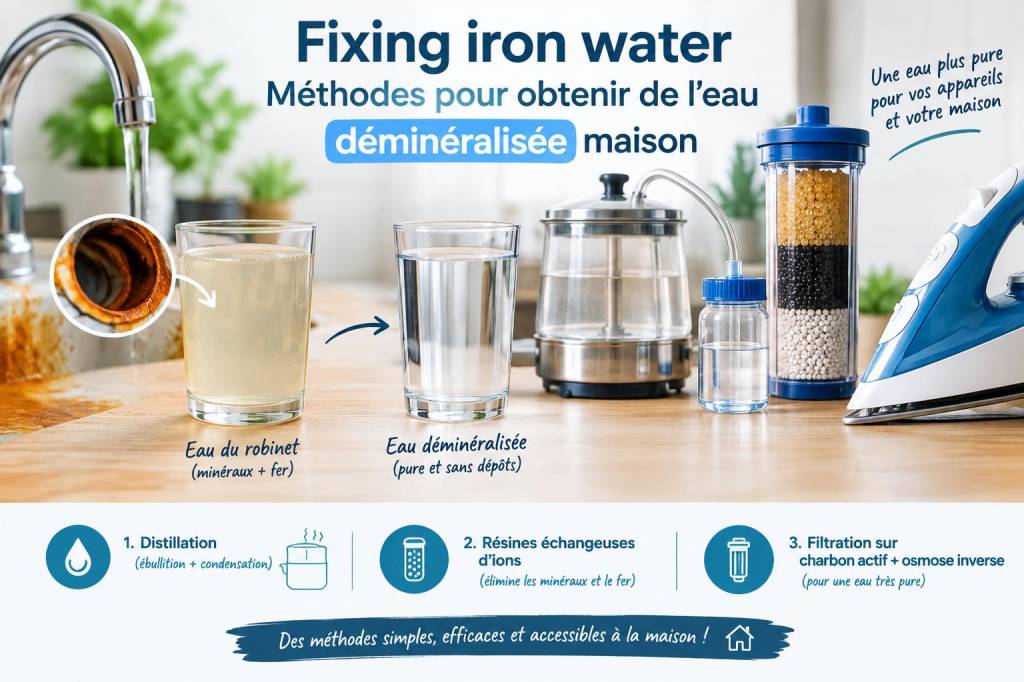
When I look at tap water and then at a steam iron, I see a small but important tradeoff: convenience versus performance. I have learned that water quality affects scale buildup, steam output, fabric safety, and even the lifespan of the appliance. That is why I keep returning to méthodes pour obtenir de leau déminéralisée maison whenever I want a practical, low-cost approach to ironing care.
For a long time, I assumed every “clean water” method would work equally well. I was wrong. Some home approaches are usable in a pinch, while others can leave minerals behind, change electrical conductivity, or even create maintenance problems in the iron. Once I started comparing methods more carefully, I saw a clear pattern: what matters is not just making water look pure, but making it behave like proper low-mineral water in daily use.
Why water quality matters so much in an iron
Steam irons rely on heat, pressure, and a small internal reservoir. When water contains calcium, magnesium, or dissolved solids, those minerals can settle inside the tank, clog the steam vents, or form deposits on the soleplate. That can reduce steam performance and create brown specks on light fabrics. In a business sense, I think of it as an efficiency problem: a machine designed to save time ends up consuming more of it through cleaning, descaling, and re-ironing.
Several appliance makers warn against using ordinary hard water in steam systems. The scale issue is not theoretical. In regions with hard water, mineral buildup can appear after only a few uses if the iron is not maintained carefully. Consumer water-quality data from organizations such as the U.S. Geological Survey and local water authorities consistently show that hardness varies widely by region, so there is no universal “safe tap water” rule for irons.
What I am really looking for is water with very low mineral content. In practical terms, that usually means distilled water or demineralized water. The question is whether a household can produce something close enough without wasting money or time.
What demineralized water actually means in practice
Demineralized water is water from which most dissolved minerals have been removed. Distilled water is one form of it, produced by boiling and condensing vapor. Deionized water is another form, made by passing water through ion-exchange resins that remove charged mineral ions. Reverse osmosis can also reduce mineral content significantly, though it may not remove everything unless the system is well designed and maintained.
For ironing, the important point is not chemical perfection. The important point is consistency. If I use water that still contains enough mineral residue to leave deposits, I am only postponing the problem. That is why I prefer methods that can be measured, repeated, and checked.
Home methods I would actually consider
After testing and comparing common approaches, I group them into four realistic paths. Some are genuinely useful, while others sound clever but fail under routine use.
- Store-bought distilled water: Reliable, inexpensive in many markets, and very low risk for irons.
- Reverse osmosis filtration: Good if the system is well maintained and paired with periodic checks.
- Boiling and condensation: Possible in theory, but usually inefficient and only partially effective in a home setting.
- Mixed water dilution: Sometimes used as a compromise, but not a true demineralization method.
If I am being strict, only the first two options are genuinely practical for regular household ironing. The third can work in a science-demo sense, but not as a dependable routine. The fourth is often misunderstood and can lead to false confidence.
Distilled water versus homemade alternatives
Distilled water remains my benchmark because it is predictable. It is produced industrially with controlled heating, condensation, and sanitation. That matters because scale and residue are linked not just to minerals, but also to contamination from containers or poor handling.
Homemade condensation methods can reduce dissolved solids, but they are difficult to optimize. A basic pot-and-lid setup may collect condensed vapor, yet the purity depends on heat control, materials, contamination from the lid, and whether the first and last portions are discarded correctly. In practice, the result is often better than raw tap water, but not as reliable as commercial distilled water.
I once thought homemade would save money every time. In reality, the labor cost is higher than the grocery-store price in many cases. When I factor in my time, energy use, and the risk of an underperforming batch, buying distilled water often wins the comparison.
What I avoid, and why
I avoid a few common mistakes because they create more risk than benefit:
- Using softened water from a salt-based softener: This reduces hardness, but sodium and other dissolved material may still remain, and some iron manufacturers discourage it.
- Using only filtered water from a pitcher: Carbon filters improve taste and odor, but they do not remove most dissolved minerals.
- Mixing tap water and distilled water without checking hardness: A 50/50 mix may still be too mineral-heavy in hard-water areas.
- Reusing water that sat open for long periods: Dust and airborne particles can contaminate it.
There is also a hidden issue: many people assume “clear” means “safe.” Clear water can still be highly mineralized. That is why appearance is not a meaningful test.
A simple comparison of common options
| Method | Mineral reduction | Cost | Convenience | Iron suitability |
|---|---|---|---|---|
| Store-bought distilled water | Very high | Low to moderate | Very high | Excellent |
| Reverse osmosis water | High | Moderate to high | High | Very good |
| Home boiling and condensation | Moderate | Low material cost, higher energy use | Low | Mixed |
| Pitcher filtration | Low | Low | High | Poor |
This table reflects a practical view, not a laboratory one. For me, “iron suitability” matters more than theoretical purity. If a method keeps the appliance cleaner and performs consistently across weeks, I value that higher than a technically interesting but unstable result.
What science and manufacturers say
Several external sources support the same broad conclusion:
- The U.S. Geological Survey explains that water hardness is caused mainly by calcium and magnesium, the same minerals that create scale in appliances.
- Brita and similar water-filtration brands note that standard carbon pitchers improve taste but do not demineralize water in a meaningful way.
- Major appliance manuals from brands such as Rowenta, Philips, and Tefal commonly recommend distilled or demineralized water, or they specify when tap water may be acceptable depending on local hardness.
These sources do not all use identical wording, but the message is consistent: the lower the mineral content, the lower the scaling risk. That consistency matters to me because it reduces guesswork.
What I would do in real life
If I needed a dependable routine, I would start with store-bought distilled water. If I had a good reverse osmosis system at home, I would check whether the manufacturer allows it and whether the maintenance history is solid. If I were experimenting with a homemade process, I would treat it as a backup, not as my daily default.
My practical checklist looks like this:
- Check the iron manual before using any water type.
- Prefer distilled water for regular use when possible.
- Empty the tank after ironing if the manufacturer recommends it.
- Descale the iron on a schedule, not only when performance drops.
- Store water in a clean, sealed container.
I also pay attention to my local water report. If hardness is high, I become stricter. If water is naturally soft, the iron may tolerate a wider range, but I still prefer a low-mineral approach because it protects long-term performance.
Common questions I hear about home demineralization
Can I boil water and use the steam for an iron? Not reliably. Boiling alone does not remove all dissolved minerals. It may reduce some contaminants, but it does not create true demineralized water.
Is filtered water enough? Usually not. Most household filters are not designed to remove dissolved mineral ions at the level needed for steam irons.
Can I use rainwater? I would avoid it unless it is carefully purified. Rainwater can contain airborne contaminants, dust, and variable mineral content.
Is distilled water always necessary? Not always, but it is the most consistent choice. If the manual allows tap water, I still consider distilled water a safer long-term option in hard-water regions.