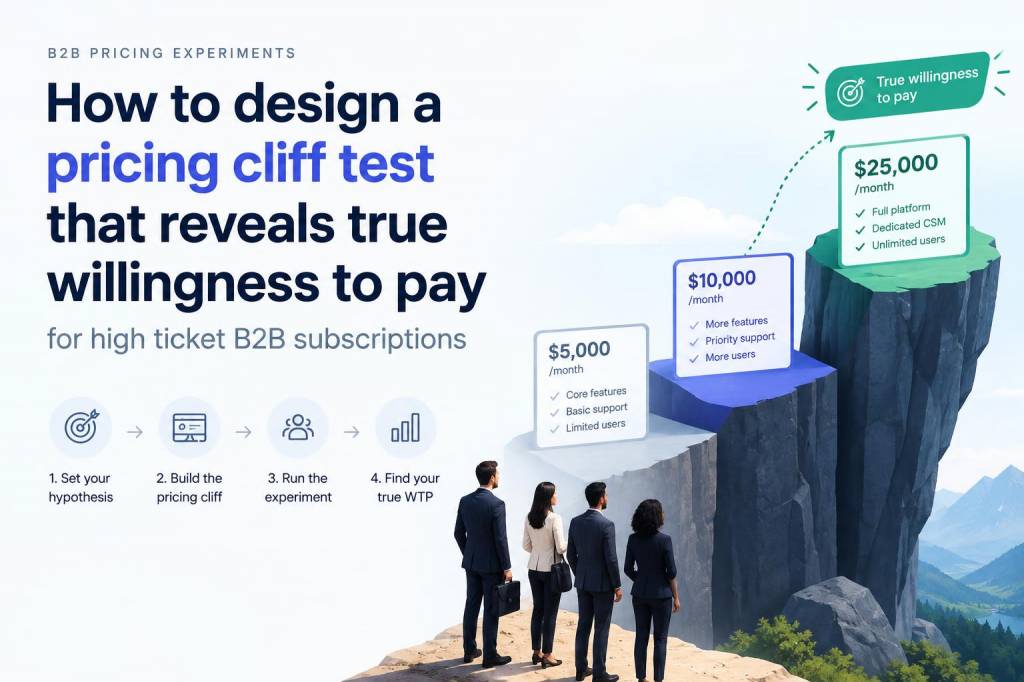
I’ve run more than a few pricing experiments in my career, but when it comes to high-ticket B2B subscriptions — annual contracts, enterprise tiers, or platforms sold to procurement teams — the usual A/B pricing tests rarely cut it. You can’t just nudge a price by 5% and hope to learn something meaningful when deals involve approval committees, integrations, and risk assessments. One approach that has consistently given me clear, actionable signals is the pricing cliff test. In this article I’ll walk you through how I design one that uncovers true willingness to pay (WTP) for expensive B2B subscriptions without burning prospects or damaging your brand.
What is a pricing cliff test and why it works for high-ticket offers
A pricing cliff test presents potential customers with a set of discrete price tiers (the “cliffs”) and asks them to choose which tier they would buy today, or which is the maximum they would consider. Unlike continuous price variation, cliffs force decision-makers to reveal preferences between meaningful, implementable price points (e.g., $30k/yr, $50k/yr, $80k/yr). For complex B2B products, that’s more realistic: buyers don’t buy at arbitrary cents; they choose between packaged contracts.
I like this method because it aligns with how procurement teams actually evaluate options. It captures not just a theoretical maximum price, but the practical selection behavior given packaging, features, and perceived ROI.
Core principles I follow when designing a pricing cliff test
Step-by-step: how I build a pricing cliff test
Here’s the exact process I use, which you can adapt to your product and audience.
Start by mapping feasible bundles. For example:
| Tier | Annual Price | Typical buyer |
| Core | $25,000 | SMB with single admin |
| Professional | $50,000 | Mid-market, 3–5 teams |
| Enterprise | $100,000 | Large orgs, SSO, SLAs |
These need to be tied to real capabilities: number of seats, integrations, support levels. If you can’t deliver the bundle at that price, don’t test it.
For each purchase segment I gather a statistically useful sample. In B2B, that often means targeting distribution channels like existing leads, customers (for expansion pricing), or curated panels of relevant job titles (e.g., VP of IT, Head of Procurement). I generally aim for at least 100 qualified responses per segment to get directional insights; more is better if your funnel allows.
I recommend this minimal flow:
Crucial: use commitment framing in the cliff question. For instance: “If you were evaluating solutions today with the need to deliver results within 90 days, which of the following annual packages would you be willing to sign a contract for?”
How to analyze cliff test results to find true WTP
Once responses are in, I look for several signals:
Statistical and practical considerations I don’t ignore
Pricing tests can mislead if you ignore context.
Examples of insights a cliff test revealed for me
One memorable test I ran for a SaaS analytics platform revealed that while 60% of mid-market respondents selected the Professional tier at $50k, only 15% of enterprise respondents chose the $100k enterprise tier. However, when we bundled a 3-month white-glove integration and a success guarantee with the enterprise tier in a second wave, enterprise selections jumped to 45%. The cliff test showed the price itself wasn’t the blocker — it was the perceived implementation risk.
Another time, a cliff test showed surprising demand for a lower “lite” tier. We had initially planned three tiers; the test suggested adding an entry-level annual plan at $18k increased overall expected revenue per 100 leads by creating a lower-friction entry that later upsold to Pro.
Operationalizing the results
After analysis I use three operational levers:
Pricing cliff tests are not a magic bullet, but they are a pragmatic, buyer-centric way to learn what high-ticket customers will actually pay. When designed thoughtfully — realistic tiers, solid segmentation, commitment framing, and careful analysis — they reveal the trade-offs buyers make and point to specific changes in packaging or messaging that unlock higher revenue.