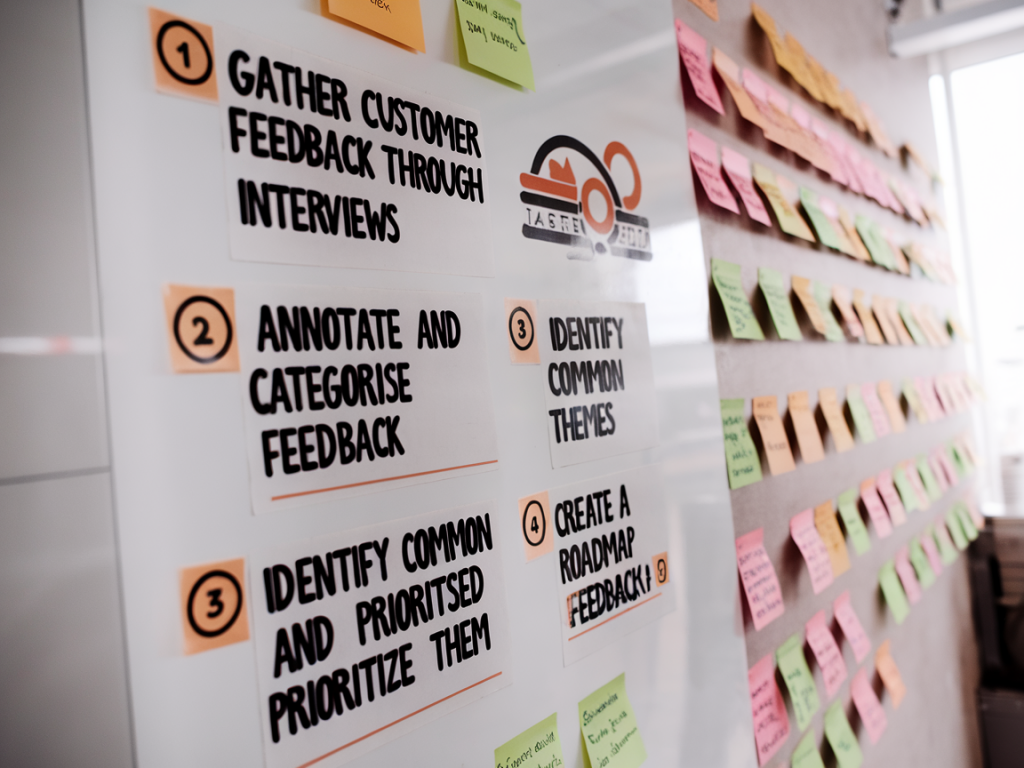
I’ve run dozens of customer interviews across multiple products and industries, and one truth keeps surfacing: raw conversations are gold, but they’re unusable until you turn them into a clear plan. Interviews reveal nuance—needs, emotions, workarounds—but converting that nuance into a prioritised product roadmap requires deliberate steps. Below I share a pragmatic process I use to convert qualitative interviews into a roadmap you can trust and act on. It’s four clear steps that mix empathy with rigor, and they’ll help you move from transcripts to decisions without losing the human insight that makes your product meaningful.
Step 1 — Make the interviews accessible and searchable
Before you can analyse anything, you need usable data. I start by transcribing interviews and centralising them. If you haven’t already, record interviews (with permission), then use a transcription tool like Otter.ai, Descript, or Rev. Don’t skimp on quality—good audio = better transcripts = fewer misinterpretations.
Once transcribed, store everything in one place: Dovetail, Notion, Airtable, or even a shared Google Drive can work. What matters is that any stakeholder can find a quote, see context, and verify decisions. I annotate as I go: highlight surprising quotes, tag pain points, and note suggested solutions mentioned by customers.
- Tip: Use consistent tagging. I tag by user persona, job-to-be-done, pain point, and sentiment (positive/negative/neutral).
- Tip: Keep an evidence link to the timestamp or original recording for every key insight.
Step 2 — Synthesize into themes and opportunities
I turn dozens of interviews into a handful of themes. This is where pattern recognition matters more than tallying ticks. I use affinity mapping—digital (Miro, FigJam) or physical sticky notes—to cluster similar quotes and behaviours. Each cluster becomes a theme and, more importantly, an opportunity statement.
A good opportunity statement follows this structure: “When [situation], users want to [motivation], but [obstacle].” For example:
- When onboarding as a new user, users want to complete their profile quickly, but they are overwhelmed by optional fields and unclear benefits.
From each opportunity I derive a potential solution concept (not a fully fleshed-out feature—just enough to estimate effort and impact). I also map themes to the user journey and to personas. This reveals which stages and user segments suffer most, which helps later when prioritising.
Step 3 — Score opportunities using impact, effort, and confidence
Quantifying qualitative insights is critical. I use a simple scoring model with three dimensions:
- Impact: How much will this opportunity improve key metrics (retention, conversion, NPS)? Score 1–5.
- Effort: How much engineering and design time is required? Score 1–5 (1 is low effort).
- Confidence: How confident are we in the problem-solution fit based on interview evidence? Score 1–5.
Then I compute a prioritisation score. I personally prefer a weighted formula that favours impact and confidence, such as:
Priority = (Impact x Confidence) / Effort
If you prefer a visual approach, place each opportunity into a four-quadrant prioritisation matrix (Quick Wins, Major Projects, Fill-Ins, Time Sinks). Here’s a simple table you can replicate:
| Quadrant | Description | When to prioritise |
|---|---|---|
| Quick Wins | High impact, low effort | Always consider for immediate delivery |
| Major Projects | High impact, high effort | Prioritise if confidence is high or strategic value is clear |
| Fill-Ins | Low impact, low effort | Do if capacity allows |
| Time Sinks | Low impact, high effort | Generally deprioritise |
Confidence is the safeguard. A high-impact idea supported by a single interview with low confidence should never jump ahead of a moderately impactful idea with strong evidence. In my work with startups, I often reclassify “big ideas” into experiments—smaller, testable chunks that increase confidence before committing major resources.
Step 4 — Build a prioritised roadmap and communicate trade-offs
With scored opportunities, I create a roadmap that is both prioritised and time-boxed. I prefer a three-horizon layout:
- Horizon 1 (0–3 months): Quick wins and experiments to validate high-risk assumptions.
- Horizon 2 (3–9 months): Major projects with clear success metrics, contingent on experiment outcomes.
- Horizon 3 (9–18 months): Strategic initiatives that require cross-functional investment.
For each roadmap item, include:
- A short problem statement tied to interview evidence (quote or persona count).
- Expected impact metric and baseline.
- Effort estimate and required teams.
- Confidence level and next experiment to raise it.
Communicating trade-offs matters as much as the roadmap itself. When I present to PM, engineering, and leadership, I always show the evidence trail: which interviews support this item, how many users mentioned it, and the confidence score. That transparency reduces debates that are actually about differing interpretations of the data.
One practical pattern I use: pair each major roadmap commitment with a small, fast experiment. If we’re planning a three-month engineering effort to rebuild search, we run an A/B test or a concierge prototype first to prove the user behaviour changes we expect. This staged approach preserves momentum and reduces wasted effort.
Finally, keep the roadmap alive. Every sprint review, I revisit the interview evidence and update confidence scores. If new interviews undermine an assumption, be prepared to drop or pivot items. Tools like Canny or Productboard integrated with your interview notes can automate traceability from insight to feature.
Turning qualitative customer interviews into a prioritised roadmap isn’t magic—it’s a repeatable mix of organisation, synthesis, quantification, and communication. If you preserve the human stories while adding a layer of pragmatic scoring and staged validation, you’ll be far more likely to build the right things at the right time.